Sunday, August 12, 2012

Playing to his strengths

At the end of most of his shows, Daily Show host Jon Stewart plays a brief video clip he calls "your moment of zen."  No commentary, just the clip.

I just got to Thursday's show this evening, and the moment of zen was a clip of Secretary of State Hillary Clinton dancing.  My first thought was, it's such an easy target.  Very few people dance well enough to make them worth watching.  Of course, Hillary has to be diplomatic and sometimes participate in things that might make her uncomfortable.  Bush certainly had to.

But Mitt Romney didn't need to sing "America the Beautiful."  He could have just quoted from it.  And Barack Obama had no need to let loose his inner Al Green.  But here's the thing: Barack pulled it off.  Mitt sucked.  Tremendously.  He had to know it would be replayed many times and that he would be savagely mocked for it.  I suppose it's possible he did it on purpose, out of some misguided attempt to appear less robotic, but I think it's more likely a symbol of the bubble in which he lives.  Either no one had told him he is tone-deaf, or they have and he thinks they're wrong.  Or he doesn't think anyone's really paying attention.

Here's what's important in this seemingly trivial point about which candidate is the better vocalist.  It's not about being tone-deaf in a clinical sense, it's about being tone-deaf in terms of how you are perceived.  I want a president who knows what he does well, and what he doesn't and needs to look to others for assistance with.  A person's greatest strength can be knowing their greatest weakness.  It's clear Mitt is clueless about at least one of his.

Saturday, June 09, 2012

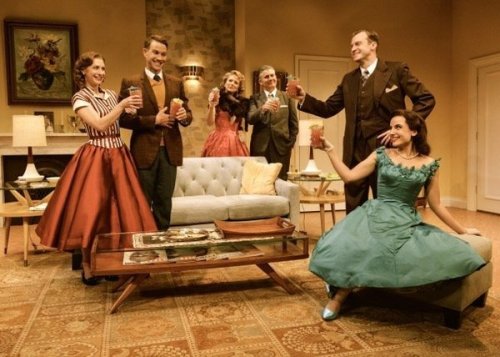
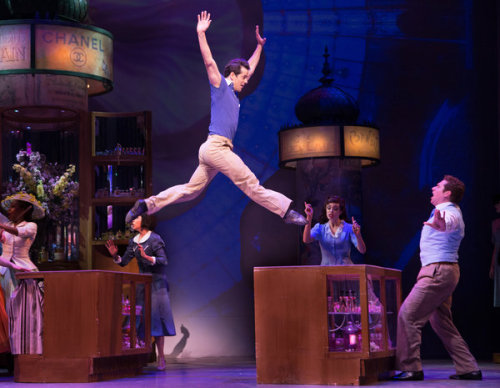
"Nice Work If You Can Get It"

Though street smarts help in this world, being rich and good-looking is usually more than enough to get by.  So says (in so many words) Matthew Broderick's character, Jimmy Winter, in the new musical at the Imperial, "Nice Work If You Can Get It."

That wisdom could also apply to Broadway musicals.   "Nice Work..," was, in a way, born with a silver spoon in its mouth:  when you start with the songs of Ira and George Gershwin as the foundation of a new production, it's hard to go too far wrong.  Add a clever book by Joe diPietro (based on some earlier work by P.G. Wodehouse and Guy Bolton) and creative contributions from the team that gave us the wonderful revival of "Anything Goes" and you've got a good chance at a pretty good-looking (and plain old good) show.

In fact, if you loved "Anything Goes" (and I did), you're probably going to at least like "Nice Work..."  Both are old-fashioned Broadway musicals: great songs, broad, silly plots, witty dialogue, handsome boys, beautiful girls, a couple of tap numbers...  It's escapist theater at its zenith.

The story of "Nice Work..." is a pretty simple one:  Jimmy Winter is an heir to some very old money, and about to be married for the fourth time.  Until, that is, the sparkling bootlegger Billy Bendix (the radiant Kelli O'Hara) enters his life.  But before they can be united, there will be misunderstandings, mischief, mistaken identities and shocking (sort of) revelations.

I won't say "Nice Work..." is a perfect show, but it's sort of like one of those memory foam mattresses - it cradles you in comfort until you're ready to start a new day.  And maybe even leave you filling a little richer and a little better-looking.

Friday, June 08, 2012

"The Columnist"

If you're a fan of "Mad Men" there's a better than even chance that you will also enjoy "The Columnist," a new play by David Auburn ("Proof"), currently playing at the Samuel J. Friedman Theatre in a Manhattan Theatre Club production helmed by Daniel Sullivan.  Like the adventures of Don Draper airing Sunday nights on AMC, "The Columnist" takes place (primarily) in the early 60s and chronicles a world in the midst of a rather epic transition.  (Not unlike another recent favorite of mine, "War Horse.")

The columnist of the title is Joseph Alsop, the mega-powerful Washington insider whose clout is suddenly diminishing as his syndicated column is finding fewer and fewer readers.  The world is changing and Alsop is having trouble keeping up.  A staunch defender of the war in Vietnam, Alsop finds himself on the wrong side of history and his desperate attempts to claw his way back to the top are the fodder for Auburn's slick drama.

In John Lee Beatty's brilliant sets, we see Alsop at his most vulnerable - pleading on the phone for favors with other Washington power brokers, trying to convince his brother Stewart (also a writer, delicately played by Boyd Gaines) to partner with him and, most important, trying to keep his closet door firmly shut.  For, as we learn in the very first scene, in a Moscow hotel room in 1954, Alsop is gay, and the impossibility of his ever coming out - balanced against the very real threat of his being outed, thanks to the existence of some surreptitiously-acquired explicit photos - keeps the tension up throughout the evening.

In addition to Auburn's excellent play and Sullivan's confident direction, "The Columnist" benefits greatly from another bravura performance by John Lithgow, who once again proves why he's one of Broadway's best.  If you're used to Lithgow's comedic roles (primarily TV's "Third Rock from the Sun"), you owe it to yourself to see him dig into a great dramatic turn such as this.  It would be hard to play Alsop without the level of bristling intelligence Lithgow brings to the role.  But it's more than his bravura and brilliance that make Lithgow great, it's also his ability to show vulnerability and doubt - not always easy for a 6'4" man to do.  It's the soft center that makes the bristly exterior interesting.

"The Columnist" occasionally feels "out of tune" - but thanks to the great team MTC put together for this production, not to mention the fascinating historical tale it weaves, "The Columnist" is a winner.

"One Man, Two Guvnors"

There are times you go to the theater to be inspired or moved, or to see a bit of the human condition revealed and made clear.

Then there is "One Man, Two Guvnors."  While I'm sure there is some satire about class and oppression buried beneath the clowning and the puns and the pratfalls, that's not the point of this adaptation of Carlo Goldoni's commedia dell'arte farce "The Servant of Two Masters," reset in 60s-era Brighton.  The point is to make you laugh.  And it does.  As long as you can laugh at silliness and exaggeration and the misfortune of others.

Primarily you will be laughing at the misfortune and antics of Francis Henshall, the harlequin played (nearly to perfection) by James Corden.  Though he looks quite well-fed, Henshall is ravenous when the play begins, seeking something - anything - to eat.  His guvnor (cockney slang for employer) hasn't paid him, so when a second job falls in his lap, he snatches it.  Now he has two bosses to please, neither of which knows about the other.

That's about it for plot.  But plot's not the point.  The plot's just there to provide excuses for Corden to perform a series of hysterical physical bits, some as old as the commedia form itself.  You might find it hard to believe that someone can make the moving of a trunk funny for 10 minutes, but Corden pulls it off - with a little help from a couple of audience members.

To be honest, of shows that pay tribute to the British pantos, I prefer "The 39 Steps," a show that played Broadway and toured the nation over the past couple of years.  It featured more theatrical invention,  a real plot and just as much inspired silliness.  Unfortunately, it's closed.  But if you're in the mood for top-notch physical comedy, "One Man, Two Guvnors" fits the bill to a T.  Or should that be "tea"?

Wednesday, June 06, 2012

"War Horse"

Some things never change: the value of loyalty, the power of love, the horrors of war.  But some things change dramatically.  The conflict between these eternal concepts set against the backdrop of a world that is being transformed by technology is at the heart of what makes "War Horse" such a powerful theatrical experience.

World War I was called "the war to end all wars."  It could be more accurately described as the "war that changed all wars."  Prior to the invention of the machine gun, the airplane, the telephone - and other innovations that were first put to use in the interest of martial ends in WWI - a cavalry rider was among the most feared weapons of war.  But once a single soldier could fire hundreds of rounds a minute, and Sopwith Camels could rain death from above, the horse and rider on the field of battle were suddenly vulnerable.

"War Horse" tells the story of Joey, plucked from his home in England, where he is much loved by young Albert, and taken to France as a cavalry horse.

I won't go deeper into the story than that, because I'd rather not spoil the many twists and turns along the way.  "War Horse" is based on a novel by Michael Morpurgo, and one of the most satisfying aspects of this production is how well the richness of the novel comes through on stage.  I love a good story, and this is a terrific one, filled with obstacles, triumph, humor and pathos.

The most commented-upon aspect of "War Horse" (the play) is that the production uses complex puppets to portray the horses (and other animals) - and with good reason, the puppets are incredible.  Every aspect of the horses are articulated. Even the ears, so important to reading a horse's mood, turn and twitch and lie flat.  The horse puppets are controlled by multiple performers, but after the first 20 minutes or so, you stop  noticing the puppeteers and see only the horses.  They even have actual breath - which I assume comes from pressurized air canisters hidden in the heads.  The overall effect is stunning.

For my readers in the Bay Area, "War Horse" is coming to the Curran Theater this August.  Though it will be impossible to recreate the experience of the enormous stage at the Vivian Beaumont Theater in New York, the magic of "War Horse" will still come through.  Like the cavalry horses of old, "War Horse" simply packs too much punch not to.

"Newsies"

In my professional life, I spend a fair bit of time dealing with branding.  Not the scars burned into livestock to establish ownership - though that is the etymology of "branding" in the modern sense - but branding in the sense of establishing and maintaining an image for a product or service or organization.  Great brands reinforce themselves over time:  Coke is about refreshment, Apple about design and user experience, Honda is about reliability and efficiency.

Disney has long been one of the most respected brands in the world, building their reputation on their ability to deliver happiness.  Disney theme parks are branded as "The Happiest Places on Earth," and if you can find a Disney-produced movie with anything other than a happy ending, I'd like to hear about it.

In the 90s, Disney branched out into Broadway musicals, beginning with "Beauty and the Beast," then adding the wildly-successful 'The Lion King," "Mary Poppins," "Aida," "Tarzan" and others, winning multiple Tony awards along the way.

Disney's most recent Broadway effort is another Tony-nominated show, "Newsies," based on the 1992 film of the same name.  And it hews closely to the Disney brand, attempting to spread happiness at every possible turn.  The story is vintage Disney: scrappy kids fighting a great power, a love interest between a princess (in this case, the fetching daughter of famed publisher Joseph Pulitzer) and a commoner (the newsboy), evil henchmen, a wacky sidekick, life lessons and ultimately triumph by curtain time.

It's a proven formula - but as we all know, following formulas usually leads to results that are, well, formulaic. That's certainly the case here.  Though the production values are high (the set, in particular, was stunning), the sense of soul is non-existent.  The performers are talented and earnest, but there's no sense of sincerity behind what makes it to the stage.  There was never a moment where I heard a clever lyric, and really only one interesting turn in the story.  "Newsies" is loud (especially the dancing) and bright and cheerful, but ultimately empty.  Which, unfortunately, is right on brand for most of what Disney has produced in recent decades.  (Save for Pixar.  In fact, what "Newsies" needs is a heaping helping of Pixardust!)

The Night Ray Bradbury Kissed Me

Last night, Ray Bradbury died at his home in Los Angeles.  I remember as a boy reading "Farenheit 451," "Dandelion Wine," "R is for Rocket," "I Sing the Body Electric" and "The Illustrated Man," and adored getting lost inside his imagination.  But my most vivid memory of Bradbury is the evening I got to meet the man himself.

It was 1981 and I was living on Sutter Street in San Francisco, working at my first real job after college, the first where I was paid to be a writer.  Bradbury came to town to give a lecture as a fundraiser for the San Francisco Public Library.  A friend was a high-level volunteer at the library and invited me not only to the lecture, but to the reception afterward, which was to be held at Arion Press, a well-respected publisher of limited-edition books.  I can't say I remember much about the lecture itself, but what happened at the reception will stay with me forever.

Arion Press at that time occupied a smallish upstairs space on Commercial Street in San Francisco.  The room was filled with the tools of a fine press: the mechanical presses themselves, drying racks for the printed pages, plus bin after bin after bin of lead type.  The Arion Press was, and still is, one of the best publishers of limited editions.  At that time, they were celebrating the publication of their edition of "Flatland," a 19th century satirical novella by Edwin Abbott Abbott, about a two-dimensional world and what happens when a character from a land of three dimensions appears in Flatland.  The book was bound in an accordion fold so the entire book could be laid out flat.  Bradbury wrote the introduction, and signed each copy. (Only 275 were printed.)

While at the party, I was offered the opportunity to purchase a copy of "Flatland," as well as a copy of Arion Press's edition of "Moby Dick."  If I remember correctly, the price for "Flatland" was $400, and a copy of "Moby Dick" would have set me back $600.  Today, a copy of "Flatland" goes for more than $6000, and a copy of "Moby Dick" recently sold at auction for more than $25,000.  Missed opportunity; but at that point, $600 was probably close to my take-home pay for a month.

When Bradbury arrived at the party, two lines formed immediately.  The great man stood at the north end of the room, backed by a couple of presses.  The guests queued up to chat with him or shake his hand.  He would talk with one person in one line, then turn to the person at the head of the second line, chat with them, turn back to the first line...

I waited patiently until it was almost my turn.  I was first in my line, and Bradbury was talking to a woman at the front of the line to my left.  She gushed something like, "I've admired you for so long and always thought you were so attractive and that maybe one day you I and would..."  It was at this point that she extended the index finger of her right hand and formed a cylinder with her left hand, curling the fingers and resting them on the left thumb.  She then proceeded to insert the index finger into this cylinder, withdraw it, insert it, withdraw it, insert it...

Bradbury blinked, recoiled and instantly turned to me and said, "Well - how are you this evening?"  I gushed about how much I enjoyed his talk, how it had inspired me as a writer, blah blah blah.  The old man (though he was only 61 at the time, he seemed ancient to me) broke into a broad smile, reached out with both his hands, grabbed me by the back of the head, pulled me close and gave me a giant kiss right on the lips.

I think I said "thank you," and shortly thereafter stumbled out into the San Francisco night.

Thursday, May 10, 2012

"Cock"

I'd like to say that "Cock" is the story of a headstrong rooster who takes charge in the barnyard in order to thwart the efforts of the farmer to do away with the rooster's best friend, a lovable lamb named Blossom or some such.  But even though the cover of the Playbill for this play currently running at The Duke on 42nd Street is a drawing of a rooster, the cock in question is exactly the kind that probably sprang to mind when you first read the word.

To tell you the truth, I don't actually want "Cock" to be the story of a headstrong rooster - or anything else - because it's an absolutely riveting play.

The story is relatively simple and straightforward: a gay couple has relationship difficulties when one of the pair meets a woman, has a fling with her and can't decide which one he ought to be with.  It's not the story that makes "Cock" such a wonderful play - it's the characters and the acting and the staging that lift "Cock" to greatness.

I won't go on about the characters, because that would be revealing too much.  What I will say is that every actor (there are four) gives a powerful, nuanced performance.  However, I must call out the work of Jason Butler Harner in the role of M.  (No, this is not a Bond film.)  M is half the gay couple - the cuckolded half, the one who learns that his partner has fallen/is falling (perhaps) for a woman.  His performance is both subtle and and outsized - in exactly the right proportion.  This allows him to be both forceful and vulnerable when he delivers lines like, "You said we would be together no matter what.  And this is what."

The staging is so simple that it's almost not there.  The theater has been set up as an amphitheater, with a 12-foot (or so) circle in the center.  (NOTE:  there are five rows in the amphitheater, but only the top row has a back you can lean against.)  There are no props, no set and no costume changes - although some are referred to.

From a thematic standpoint, there is a strong undercurrent of sexuality as a choice.  Is John (the character torn between two people) gay?  Straight?  Bi?  How much choice does he really have in the matter?  Does choice matter in terms of sexuality?  In other words, even if it were a choice, why should that make any difference in the way we treat each other as individuals or as members of a community?

These are questions you will have to answer for yourself - and I strongly recommend you see "Cock" in order to get the conversation started.

Monday, May 07, 2012

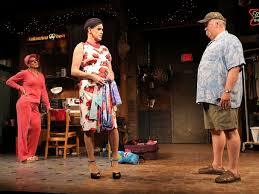
"4000 Miles"

Sweet, lovely, touching, but mostly forgettable.  A simple story of a young man, a self-described hippie, who drops in on his aging grandmother, a card-carrying communist living in Greenwich Village, after he has ridden from Seattle to New York, with at least one major tragedy along the way.  The set is terrific -- perfect for Grandma's rent-controlled apartment, right down to the rotary phone and case of cassette tapes on the bookshelf, even though it's set in the present day.  All the actors do excellent work, though Greta Lee really steals all the attention when she's on stage.  Mary Louise Wilson does a terrific stooped older woman, and it all feels honest - but it just never engaged me quite as deeply as I'd like.

"The Common Pursuit"

A better soporific than Ambien.

"Venus in Fur"

Where to begin?  This is the question every writer faces.  Every other professional in the world of entertainment gets to start their task with something - a script, character sketch, director's instructions, whatever.  But it is we poor writers who must summon a something out of sheer nothingness.

Fortunately, this writing task is a little easier.  I get to start with another writer's work - specifically, David Ives' staggeringly-brilliant play, based in part on the 19th century novel, "Venus in Fur" by Leopold von Sacher-Masoch, one of the books that introduced the world to S&M.  (The "M," of course, being inspired by Sacher-Masoch's name.)

But that sense of terror writers face is present at every moment of this 90-minute two-hander.  It begins with playwright and director Thomas (Hugh Dancy), who has written an adaptation of "Venus in Fur" and is conducting auditions for an actress to play the part of Vanda, the lead character.  Finding no one suitable, he's ready to give up until a young actress - conveniently also named Vanda - steps through the door and proceeds to turn his world upside down.  Which makes sense, because that's what sadists do.  Sadism isn't really about inflicting pain, it's about engendering terror.  Creating chaos so the masochist can experience the terror of not knowing what's coming next.

Thomas is already living in terror, and Vanda only ups the ante.  Here he is, the writer, the director, the man in control.  The person who has created a whole world and thinks he's in charge of it.  At least until Vanda arrives and throws all his expectations out the window.

Both Hugh Dancy and Nina Arianda are wonderful, and it will be a travesty of justice if Nina does not walk away with the Tony.

There is so much richness, so many layers of meaning and plot and character, that I can't really do this justice without giving too much away.  "Venus in Fur" is like one of those Russian nesting dolls - you keep unpacking it and it keeps revealing something new.  This isn't a show about sadism or masochism, necessarily.  It's also about art and theater and the masks we wear - and ask others to wear.

Wear whatever you like - but go.  As soon as you can.

Sunday, May 06, 2012

"The End of the Rainbow"

If you've read anything about this show - playing at the absolutely gorgeous Belasco Theatre - you've probably read about Tracie Bennett's powerful performance, which many are saying could win her this year's Tony.  True, her portrayal of Judy Garland during her last series of concerts is thrilling, but it's not enough to overcome the fact that the play itself is rather insubstantial.

With all the drama surrounding Judy's last months - the pills, the booze ("Whenever I drink water, I always feel I'm missing something."), the gold-digging younger fiance, more pills - you'd think it would be hard to make a play as uni-dimensional as this.  But they managed somehow.

Some of the fault lies with writer Peter Quilter, though I place far more of the blame at the feet of director Terry Johnson, who has created some abrupt transitions in the performances, so that his actors suddenly blow up in rage with no truly adequate motivation for doing so.  Garland was an addict, but she wasn't stupid or crazy.  Bennett has the Garland poses down, as well as the vocal tics, but ultimately she can't transcend the plodding clumsiness of the production.

"Other Desert Cities"

One of the primary requirements of great drama is to have something at stake.  Something real, important and true.  Something that the characters care about - and, by extension, something we care about.  In "Other Desert Cities," now playing at the Booth Theater after a highly-successful off-Broadway run, there's plenty at stake: primarily, the survival of a family (the Wyeths), but also the survival of each character's image of themselves.  As a good parent, as an artist, or as a free and happy "half-boy hipster."

The play takes place mostly in 2004, as the Iraq War was starting to ramp up, and the tension between Polly and Lyman Wyeth (the very Republican parents, played by Stockard Channing and Stacy Keach) and their two children, Brooke (Elizabeth Marvel) and Trip (Matthew Risch) is palpable from the first scene.  The stakes (and the tension) only go up when it turns out that Brooke, whose first novel was a big success but who has suffered from writer's block in the years since, has written a memoir of the family, focusing on her long-dead brother, about whom no one has been allowed to speak.

The family (including alcoholic Aunt Silda, played by Judith Light) has gathered in their Palm Springs home (a brilliant set by the virtually-always brilliant John Lee Beatty) for Christmas.  Even though they're Jewish.  Brooke has flown in from Sag Harbor ("Living on the East Coast has led you to believe sarcasm is both charming and alluring," her mother says), bringing with her the manuscript for her unpublished (but already sold) book.  The family assumes it's another novel, but like so many assumptions people make, this is wrong.  When the family learns her real plan, everything starts falling apart.  But in a good way. At least for the audience.

Telling the truth can be an expensive proposition, and it certainly is for the Wyeth family, at least in terms of their emotions.  Stockard Channing is stunning as the matriarch who watches what she feels she's built over decades fall apart in the course of a day or so.  Stacy Keach gives a performance that is a great match for Channing.  (I loved the bit when his character - a movie star turned politician - shows just how easy it is for him to die convincingly.)  Marvel, Light and Risch all do great jobs, as well.  In fact, I can't find much to criticize about "Other Desert Cities," other than wishing it had gone on a bit longer.  I'd love to see how this family is changed by the revelations made in the shadow of their gold-flocked Christmas tree.

Thursday, May 03, 2012

Gore Vidal's "The Best Man"

I so wanted to like "The Best Man," I really did.  Ultimately, I enjoyed the evening (2 hours, 40 minutes, two intermissions), but probably because I was in a generous mood and willing to forgive its clunkiness -- which was enough to make Click and Clack, the Tappet Brothers squirm in agony.

It's true, as many reviewers have pointed out, that much of the play still resonates in today's political climate -- the venality, the sucking up to power (with the non-stop nature of a Dyson vacuum), the sham marriages, the chattering class always at the door...  Plus, the cast is as star-packed as anything I've seen on Broadway:  James Earl Jones, Angela Lansbury, Candice Bergen, John Laroquette, Eric McCormack and Michael McKean.  The problem is, only Laroquette really found a true character.  Which is fitting, since he plays William Russell, the only truly principled character in the drama.  Laroquette stands as a solid pole supporting a very big tent.

Unfortunately, the other major players don't seem to really be engaged with their roles.  Candice Bergen is too casually chilly in her role as the good candidate's wife, and Eric McCormack's southern accent wanders in and out to the point that you can't tell whether he's supposed to be from Mississippi or South Carolina or just auditioning for every role in "Steel Magnolias."  Angela Lansbury, lovable and adored as she is, simply doesn't have the power to seize the stage the way she once did.  (The fact that she is the only cast member who had to be mic'd is one good sign of that.)

"The West Wing" this is not.  Today's politics is about speed and volume and continuous news cycles.  "The Best Man" is much more linear and old-fashioned.  It's of the day when there were three networks and a handful of major papers.  Which is delightful if you're in a nostalgic mood.  But given the stakes in our current political battles, we don't need a creaky, stuffy period piece.  Battling intolerance and ignorance requires a much sharper saber than Vidal's 1960 play.  As one character says "I'd like to think intelligence is contagious -- but I'm afraid it isn't."  As the kids say, true that.

"The Lyons"

There is often a moment in a play when a character delivers a line that perfectly encapsulates the mood or the message of the work.  In "The Lyons," playwright Nicky Silver's first foray onto Broadway, the line goes something like, "You're all horrible people and I hope never to see any of you again!"

This line is spoken by Curtis Lyons, the youngest child of Rita and Ben Lyons.  Ben doesn't much care for his son.  Or his daughter, Lisa.  They're both huge disappointments, and now that dad is dying (the first act takes place in a hospital room), he feels liberated to say exactly what he thinks.  For instance, he thinks his son is "a creep."  His wife, Rita, is "a bitch."  To be honest with you, I'm inclined to agree.  Apart from the nurse (played with a gentle strength by Brenda Pressley), no one is likeable.  They're all family, but they certainly don't seem to love each other -- or themselves, for that matter.

They do have one thing going for them -- they're fictional.  They're often funny, but they're also often pitiful and cruel and self-absorbed and standoffish and, yes, creepy.  But they're on the other side of the proscenium where they belong.  And where we can enjoy how marvelously they are played by a terrific cast led by Linda Lavin, who is on pretty much everyone's short list to win the Tony for this role.

The acidic nature of their characters seem to have eaten through any familial connections that might once have existed.  The "icy, glacial blue" Rita imagines for the living room she wants to redecorate as soon as her husband hurries up and dies already loses its luster from the moment the curtain rises and ends up -- in Rita's words -- the "washed-out shade of dashed hopes."  This family doesn't talk with each other, or even to each other, if they ever did.  They only ever seem to talk at and through each other.  But that's the way they like it.  As Rita says, "no one feels comfortable with they're intimate."

Sunday, August 07, 2011

Revenge (served piping hot)


Last week, Tiger Woods announced two things. First, that he was coming back to the PGA Tour after three months off due to injury. Second, that he had fired his long-time caddy, New Zealander Steve Williams. In many ways, this second piece of news was the bigger bombshell. Certainly Williams didn't take it well, and the animus he felt at his firing was clear from some of the comments made after he was downsized by the former number one golfer in the world.

Today, though, Stevie got his revenge. After Tiger had let him go, Australian Adam Scott put Williams on his bag for this week's WGC Bridgestone Invitational, a tournament Woods and Williams had teamed up to win seven times previously. Based on the results, perhaps Steve's expertise at the Firestone Country Club was more valuable than Tiger thinks, as Williams guided Scott to a four-stroke victory.

In a giant "neener-neener" to his former boss, Williams was quoted after the event as saying that of all his 145 wins on tour as a caddy (including multiple victories at all four majors), that this was "the best week of my life."

Tiger, meanwhile, finished over par for the tournament, tied for 37th. Another helping of humble pie, Mr. Woods?

Saturday, July 30, 2011

James Lipton - Spectacularly Wrong


James Lipton has never been one of my favorite television personalities. It's not that he's annoying, just a bit pompous. Not that there's anything wrong with that. At least if your pomposity has some justification, like being right virtually all the time.

Last night, Lipton was a sort of host at the SF Symphony's night of movie music, part of its summer series. Two things happened that cemented my opinion of Lipton as a public personality. First, when he stepped on stage, he discovered his TelePrompter was not working. When he realized it was going to take more than a minute to get it operational, instead of chatting with the audience -- or ever greeting us -- he stood in stone silence as the tech crew assembled to get things running. Finally, after a few minutes, the conductor got the symphony playing something to fill the silence.

But the worst of his offenses came in the last of several commentaries about the music the symphony was playing. These were mostly interesting, but in his comments about "E.T., The Extra-Terrestrial," he spoke with great conviction that it was the "willpower" of Elliott and his friends that made the bicycles fly. Poppycock! It's clearly E.T.'s powers that gets the bikes airborne. He uses his powers earlier in the film to refresh a faded flower and to heal a cut on Elliott's finger. Plus, during that sequence, Spielberg puts the camera on E.T. to show his eyes narrowing in concentration. It's SO completely wrong-headed. I just can't imagine how he got it so wrong.

And this is my outlet for my indignation.

Monday, June 06, 2011

Portraits in Contrast


A book of photography devoted to similar portraits of highly dissimilar (in many -- but not all -- ways) people.

Wednesday, April 27, 2011

New York, April 2011 - Day Thirteen, "The School for Lies"


“The School for Lies”
Hamish Linklater probably thinks I’m stalking him. On my last trip to New York, he was in the same audience as I was at two different shows – something we both noticed. Earlier on this trip he was in the audience at “TIHGTOCASWAKTTS.” This time, however, no coincidences were required – he’s starring in David Ives’ brilliant, biting, hilarious adaptation of Moliere’s “The Misanthrope.”

Ives has translated the classic into mostly contemporary language – but he’s kept it in verse, which sounds like it could be clumsy – but it rarely is. And since Ives has his characters using words and phrases that wouldn’t sound out of place on any street corner or college dorm – “What’s yours or mine or any man’s friendship worth, if you give it to any douche on Earth?” – it still feels incredibly current and relevant. Which, of course, adds to the bite when Moliere’s timeless satire is aimed not just as mendacity (as the title implies), but politics, society and culture. (“Sycophants who are brown well past their noses,” was another favorite of mine.)

You’d have to really hate verse not to find something to like about “The School for Lies.” Linklater (who you might know from his TV work on "The New Adventures of Old Christine") is deadpan funny, and his supporting cast mostly just as sure-footed. Ives’ script delivers zinger after zinger and one inventive rhyme after another. And if that doesn’t sell you, it’s worth the ticket price just to see William Ivey Long’s costumes. (John Lee Beatty’s set is lovely, too.)

If you love language, don’t miss this one.

New York, April 2011 - Day Twelve, "Carson McCullers Talks About Love"


“Carson McCullers Talks About Love”
I went to this show not because I’m a huge Carson McCullers fan (I’ve never even seen the movie version of “The Heart is a Lonely Hunter,” let alone read it or any of her other books), but because of the two composers, singers/songwriters Duncan Sheik and Suzanne Vega. I owned (and enjoyed) Vega’s crossover album, “Solitude Standing,” and loved both Sheik’s one radio hit (“Barely Breathing”) and his score for “Spring Awakening.” And since Vega was singing the title role of McCullers, I went to one of the first previews.

I think they may have something here, even though the book needs a fair bit of work (it’s too soft and mundane right now) and Vega is a much better actress when she is singing.

First, the material is incredibly rich. McCullers is a tragic figure, successful and famous before she was 25, her left side paralyzed by a series of strokes before she was 31, and was dead at 50. In those few years, though, she lived and loved and wrote and hung out with the cream of the New York intellectual scene: Truman Capote, Paul Bowles, Tennessee Williams, W. H. Auden, et al.

Second – and more important to the show’s future – the songs are lovely. Some haunting, some sprightly, all delivered tenderly by Vega. I’d buy the album today if they had one. When she stands, near the end of the show, her left arm pinned to her side (the effects of the stroke) and intones “Do you know how love should be begun? A tree. A rock. A cloud,” it simultaneously broke my heart and filled me with hope.

Part of that hope is that the producers find a way to reach an audience larger than the 95 who can fit inside the village’s Rattlestick Theater.

(Odd synchronicity: just as I finished this review, “Solitude Standing” began to play in iTunes, after the instrumental music I had chosen to write to – the soundtrack from “The Social Network” - had finished.)

New York, April 2011 - Day Eleven, "The Importance of Being Earnest" & "The Intelligent Homosexual's Guide..."


The Importance of Being Earnest
Yes, you’ve probably seen it before, most likely at a local high school. “Earnest” has been a staple of youth theater for decades. The problem is, kids miss the satire present in the farce. Brian Bedford, the director and star of this wonderful new production, most assuredly does not. Beneath the veneer of the very correct manners on display, the blood is flowing freely. And not just from the characters – Wilde himself is skewering the aristocracy for their idleness. His references to “The Society for the Prevention of Discontent in the Upper Classes” and an article titled “The Influence of a Permanent Income on Thought” are just two of my favorite examples.

All the Wilde wit is on display, the costumes – especially the gowns created for Bedford’s portrayal of Lady Bracknell – are stunning, and the cast is terrific.

Even if you’ve seen “Earnest” many times, I doubt you’ve seen a production as top-notch as this one.


“The Intelligent Homosexual’s Guide to Capitalism and Socialism with a Key to the Scriptures”
Gus thinks he’s losing his mind. Though none of his children or his sister can sense the change – he’s the same card-carrying communist worker’s organizer homophobic curmudgeon he always was – Gus can sense things slipping away from him. Out of his grasp. Out of his control. He’s decided it’s Alzheimer’s.

So he’s decided to kill himself. For real this time. His first attempt came on the anniversary of his wife’s death. Which also happened to be their son Pill’s birthday. Now it’s a few days past that anniversary and Dad is laying out a new set of final plans. “You were going to give him a matched set?” his brother Vito asks.

Think of this show as a complement to “August: Osage County.” That story begins with a father missing (soon revealed to be suicide) and a family coming together to deal with each other. Here the family assembles to deal with the father. To decide – in a collective, consensual fashion, true to their communist roots – whether or not he ought to be allowed to exercise this option. And, like “August: Osage County,” it takes more than three and a half hours to determine what is to be done about dad – and it absolutely flies by.

“TIHGTOCASWAKTTS” is the latest by Tony Kushner, who won the Tony and the Pulitzer for “Angels in America,” and I have to admit it’s the sort of thing I tend to like: lots of talking, lots of ideas, wit, banter, intimate secrets revealed… With that caveat, I’ll tell you that I was enraptured by it.

Some of the performances got a little out of tune now and then, but they’re still in previews, so I’ll assume they can iron those out. And while they’re at it, I bet Tony will make some cuts to help the show move just a touch faster.

Even as it is, “TIHGTOCASWAKTTS” is deeply compelling. Every character has something at stake, each revelation has echoes and overtones. When Gus explains why he wants to check himself out, he tells the story of a friend of his, a typesetter, whom he watched slip away into dementia, his hands reflexively making the motions of his work even as he lay slowly dying in a hospital bed.

Typesetting. Communism. Homophobia. What do these three have in common? They are all dead concepts – save for a dwindling minority who still cling to them. In the case of homophobia, it’s a significant minority – at least in the U.S. While steady progress is made (the lifting of DADT, the President’s refusal to defend DOMA, marriage equality in five states and DC), the beast of hatred can, in its death throes, still claims victims: those bullied to death, partners forced apart by immigration laws, homes torched by arson. The list is long.

So is “TIHGTOCASWAKTTS.” But Kushner uses the time wisely to explore the consequences of hanging on to dead ideas. Highly recommended. (At least, if it sounds like your kind of thing, too.)